

Introduction
Every signage project begins with a concept — a logo, an architectural vision, or a brand experience that needs to be transformed into a physical product. However, the journey from design to reality involves far more than creative ideas. Behind every finished sign is a combination of material knowledge, manufacturing expertise, and specialized equipment that enables accurate and reliable production.
For businesses, architects, and designers, the quality of a finished sign is often judged by its appearance, durability, and ability to represent a brand consistently. While these results are visible after installation, they are largely determined during the manufacturing process. Understanding why production equipment plays such a decisive role is a key step toward achieving flawless signage execution.
The Strategic Value of Equipment
Modern signage projects increasingly require customization, complex structures, and consistent quality across different applications. Whether producing illuminated channel letters, architectural signage, retail displays, or branded environments, manufacturers need suitable equipment to translate design requirements into precise physical components.
Equipment does not replace craftsmanship; instead, it enhances the ability of skilled teams to achieve greater accuracy, repeatability, and efficiency. Advanced production equipment allows manufacturers to process different materials, handle complex geometries, and maintain consistent results across both customized and larger-scale projects.
For customers selecting a signage partner, understanding the role of production equipment provides valuable insight into a manufacturer's technical capabilities and ability to deliver reliable outcomes.
How Equipment Supports the Sign Production Process
Turning a design concept into a finished sign requires a series of coordinated production steps. Different types of equipment support different stages of this process, helping manufacturers achieve accuracy, structural reliability, and consistent visual quality.
While each project may involve different materials and fabrication methods, the role of equipment remains essential in transforming digital concepts into durable physical signage.

1.From Digital Design to Physical Components
The first stage of sign production is converting digital designs into accurately processed components. Before a sign can be fabricated, materials must be cut, shaped, and prepared according to specific design requirements.
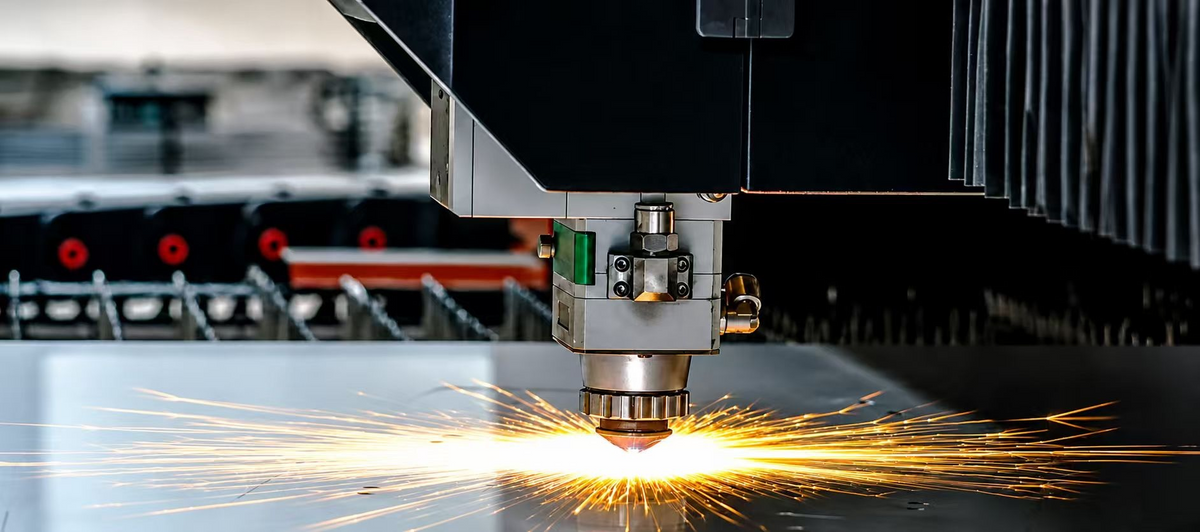
Precision equipment such as fiber laser cutting machines and CNC engraving machines enables manufacturers to create detailed components with consistent dimensions and repeatable accuracy. These processes establish the foundation for subsequent fabrication, ensuring that the final product can closely match the original design intent.
2.From Components to Finished Structures
After individual components are prepared, fabrication equipment transforms them into complete signage structures. Many professional signs require dimensional forms, internal frameworks, and precise assembly to achieve both visual impact and structural stability.
Equipment such as bending machines and welding systems supports the production of channel letters, illuminated signage, cabinets, and architectural signage elements. The accuracy of these processes directly influences the appearance, strength, and installation performance of the final product.
3.From Fabrication to Final Appearance
The final stage focuses on refining the appearance and performance of completed signage components. Surface finishing and graphic production processes help achieve the desired texture, color, and long-term durability.
Finishing equipment such as grinding, polishing, brushing, and sandblasting systems improves material appearance and consistency, while digital printing and lamination equipment enables customized graphics and protective finishes.
Together, these processes ensure that the final signage not only meets design expectations but also performs reliably in real-world environments.
Choosing a Signage Partner with Comprehensive Production Capabilities
For customers, evaluating a signage manufacturer involves more than reviewing finished project images. Understanding the production capabilities behind those results provides a clearer picture of how a supplier manages quality, customization, and different project requirements.
A capable signage manufacturer relies on appropriate equipment across key production processes, combined with technical expertise and experienced craftsmanship, to transform creative concepts into durable signage solutions. An integrated production system enables manufacturers to maintain consistent quality, improve workflow efficiency, and support a wide range of customized applications.
For businesses and organizations managing complex signage programs, especially multi-location branding projects, scalable production capability is an important factor when selecting a signage partner. The ability to coordinate specialized equipment, skilled production teams, and established processes allows manufacturers to deliver consistent results across both customized projects and larger-volume requirements.
Supported by an integrated equipment portfolio and experienced production teams, LC Sign has developed scalable manufacturing capabilities for diverse signage applications. Our production capacity covers illuminated signs, LED signage, light boxes, and large-scale signage projects, enabling us to support different project requirements while maintaining consistent production standards.

Explore the Essential Equipment Behind Professional Sign Production
While understanding why equipment matters sets the foundation for quality control, knowing which technologies power each fabrication stage completes the picture. To help industry professionals better understand the equipment that supports modern signage production, LC Sign has developed a white paper: Essential Equipment for Sign Manufacturing: A Guide to the Technologies Behind Professional Sign Production
This guide provides an overview of essential equipment used in professional sign manufacturing, explaining their roles, applications, and contribution to different production processes, including cutting, engraving, fabrication, surface finishing, and graphic production.
Recommended reading
How Global Logistics Is Being Redesigned for Speed, Cost Efficiency, and Greater Predictability
From Pantone to Production: How Color Consistency Is Achieved in Sign Manufacturing
From Production to Site: How Upstream Optimization Improves Signage Installation Efficiency
5 Certifications behind LC sign’s Commitment to Quality and Credibility