

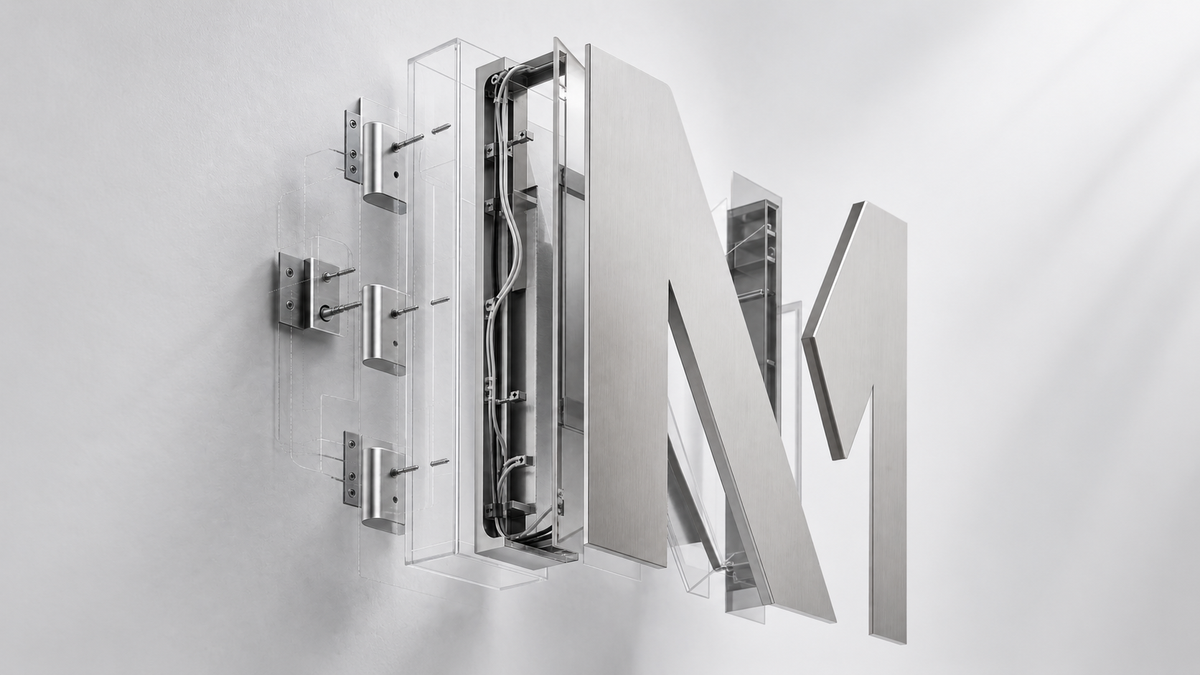
In the global signage industry, field installation efficiency directly impacts project schedules, labor allocation, and overall operational costs. Because field environments are inherently complex and variable, physical mounting constraints, electrical routing, and hardware requirements demand careful anticipation during the fabrication phase. When these technical barriers are addressed prior to crating, the technical complexity at the installation site drops significantly, helping to prevent unexpected field expenses, project delays, and costly callbacks.
At LC Sign, we believe that signage manufacturing involves engineering considerations that extend far beyond ex-factory quality checkpoints. A proactive approach focuses on embedding early-stage optimizations into the product design so that on-site assembly is streamlined long before the shipment arrives.
Pre-Production Technical Alignment: Verifying Site Conditions and Substrates
A seamless site deployment relies on a rigorous engineering review before fabrication begins. Proceeding without confirming the exact conditions of the architectural destination often leads to unexpected complications and field modifications. To ensure structural compatibility, LC Sign initiates a granular technical consultation with clients to establish a customized plan.
1.Climatic Adaptability
Evaluating indoor versus outdoor exposure guides critical engineering decisions. For outdoor applications, this ensures the integration of high-grade waterproof LED modules, outdoor-rated power supplies, and strategically positioned weep holes within the chassis to guarantee long-term weatherability.
2.Substrate Structural Verification
For any application—whether wall-mounted, freestanding, or ground-embedded—it is essential to clarify the exact composition and load-bearing capacity of the substrate, such as concrete, solid masonry, steel structures, or wood backing. Verifying these physical properties allows our engineering teams to calculate load requirements and determine the correct anchoring methods well in advance.

Upstream Electrical Configuration: Adapting to Field Wiring and Integration Methods
Aligning a product's power configurations with local field constraints is a highly effective way to optimize the on-site workflow. By doing so, LC Sign eliminates typical errors linked to complex field wiring, voltage mismatches, or conflicting wiring standards that frequently stall installations.
1.Plug-and-Play Integration
For signs utilizing interior wall outlets or localized display power, organizing the electrical connection into a pre-wired setup delivers excellent field efficiency. Supplying the signage with a certified power supply adapter and an integrated power cord tailored to the destination country's electrical standards, such as US or EU specifications, simplifies the entire onsite process. Field crews can bypass complex stripping or crimping, illuminating the sign through a direct connection.

2.Field Hardwiring Solutions
For architectural projects requiring centralized remote power or direct connection to a building's electrical junctions, signs are best engineered with standard cables extended to an ample length for clean routing through building structures. LC Sign's factory assembly strictly follows international IEC wire color standards—using brown/red leads for line (live) connections, blue/black for neutral, and a green-yellow dual-color wire exclusively for ground. This standardized color coding removes the guesswork for installers, accelerating wiring efficiency and protecting electrical components from burnout.
Deployment Packages: Tailored Stencils and Hardware Kits
To prevent layout friction and hardware shortages that stall operations, LC Sign combines structural positioning templates with location-specific mounting components into pre-engineered installation packages.
1.Pre-Engineered Stencils
Complex multi-letter layouts are optimized by digitizing positioning during manufacturing. LC Sign provides a 1:1, high-precision digitally printed stencil tailored to the verified facade. Template materials are chosen based on the environment: standard layout paper supports dry indoor applications, while high-tensile, tear-resistant banner materials are utilized for exposed, windy outdoor surfaces. This allows field crews to secure the template onto the facade to instantly map out letter spacing, level lines, and drilling points, minimizing manual measurements.
2.Location-Specific Hardware Kits
Before crating, project-specific fasteners, threaded rods, expansion anchors, sleeves, or decorative screw caps are pre-packed into modular kits matching the verified substrate. Instead of supplying loose, mixed hardware, components are systematically grouped and labeled by specific signage location. Additionally, these kits include an extra 10% allowance of critical fasteners to account for potential on-site loss.
Upon unboxing, field crews receive an organized, location-specific kit dedicated to that exact installation point. This streamlined framework removes the need to sort through mixed parts, prevents component shortages, and reduces the need for impromptu site adjustments. Contact us to request a quotation for your signage project.
Conclusion: Engineering Complexity in the Factory, Delivering Simplicity to the Site
Efficient signage deployment begins long before fabrication, starting with upfront technical alignment. A smooth installation relies on checking site conditions and substrates early, customizing electrical setups, and providing 1:1 stencils with pre-sorted hardware kits. When the factory handles this technical complexity, the on-site work becomes fast and simple. This preparation slashes installation time, allowing clients to save on labor costs, maintain tight schedules, and ensure long-term performance across global networks.
Recommended reading
5 Certifications behind LC sign’s Commitment to Quality and Credibility
How Global Logistics Is Being Redesigned for Speed, Cost Efficiency, and Greater Predictability
From Pantone to Production: How Color Consistency Is Achieved in Sign Manufacturing
From Design to Reality: Why Equipment Matters in Modern Sign Production