

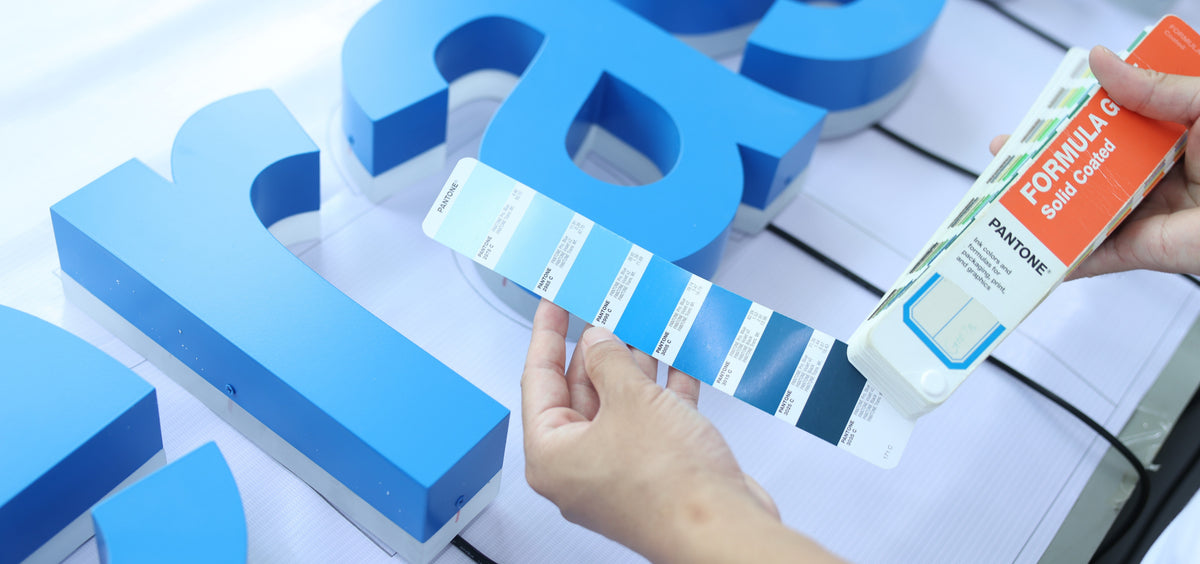
Color is more than a visual detail in signage. For a brand, a specific color can be an important part of its visual identity, and even small variations across locations can affect how consistently that identity is presented.
So how does a sign manufacturer turn a brand color specification into a physical sign—and ensure that the same color can be reproduced across different production batches?

Pantone: Establishing a Common Color Standard
The Pantone Matching System (PMS) provides a standardized language for communicating color between designers, brands, and manufacturers. Instead of describing a color simply as "dark blue" or "bright red,” a brand can specify a precise Pantone reference such as PANTONE 186 C.
The suffix is important. In the Pantone Graphics system, C means Coated and U means Uncoated, referring to the paper stock used to produce the physical color reference. Because the same ink behaves differently on coated and uncoated paper, PANTONE 186 C and PANTONE 186 U can have different visual appearances.
This does not make the Pantone standard less precise. Rather, it shows why the correct color reference and the intended application conditions need to be clearly identified from the beginning.

From Pantone Color to Signage Paint
Pantone provides the target color standard, but a sign may be manufactured using painted aluminum, stainless steel, acrylic, PVC, or other materials rather than printing ink on paper.
This is where professional paint color matching comes in.
Paint manufacturers and coating suppliers use their own formulations and color-matching systems to reproduce a target color. The matched color must then be evaluated under the actual production conditions, because the final appearance is affected by the substrate, coating system, finish, and application process. Pantone also notes that paint matched to a Pantone reference may not be an exact match because formulations vary by manufacturer, substrate, finish, and application method.
For this reason, a reliable production process does not stop at finding a paint formulation. A physical sample is produced and evaluated against the approved color reference before the color is released for production.
Why Materials and Finishes Matter
A brand may specify one color, but that color can be produced on many different signage materials.
The same target color can appear different depending on the substrate and surface finish, including:
- Powder-coated or wet-painted aluminum
- Stainless steel
- Acrylic
- PVC
- Matte or gloss surfaces
- Translucent materials used for illuminated signs
Surface texture and gloss affect how light is reflected, while translucent materials and LED illumination can further influence perceived color.
This is why color consistency in signage means more than simply using the same color code. The material, finish, lighting conditions, and manufacturing process also need to be considered.

How Sign Manufacturers Control Color Consistency
For a single sign, a slight variation may be difficult to notice. For retail chains, franchise networks, and large-scale signage rollouts, however, consistency becomes much more important.
A professional color-control process typically includes:
1. Confirm the color standard
Identify the approved Pantone reference and clarify the required material, finish, and application method.
2. Match and test the color
Match the target color using the selected coating system and test it on the intended substrate.
3. Prepare a color sample for approval
Produce a physical color sample using the specified materials and production process, then submit it for customer approval before mass production.
4. Control production variables
Keep the material, paint formulation, surface preparation, coating process, and curing conditions as consistent as possible between batches.
5. Inspect finished signs
Compare production samples against the approved standard and use appropriate color measurement methods when tighter tolerances are required.

Color Consistency Is a Process, Not Just a Color Code
Pantone gives brands and manufacturers a common language for specifying color. The challenge in signage production is taking that standardized target and reproducing it consistently under real manufacturing conditions.
For professional sign manufacturing, color consistency therefore depends on a complete chain:
Color Standard → Color Matching → Material & Finish → Physical Sample → Production Control → Quality Inspection
When this process is properly controlled, a brand color can remain recognizable and consistent across individual signs, production batches, and multiple locations. This is especially important for retail chains, franchises, and large-scale signage rollouts, where consistent signage helps maintain a unified brand identity across markets.
At LC Sign, we apply the same color-control approach to both individual and high-volume signage projects, using approved color standards and physical samples as production references. Contact LC Sign to discuss your signage project and color requirements.
Recommended reading
From Design to Reality: Why Equipment Matters in Modern Sign Production
How Global Logistics Is Being Redesigned for Speed, Cost Efficiency, and Greater Predictability
From Production to Site: How Upstream Optimization Improves Signage Installation Efficiency
5 Certifications behind LC sign’s Commitment to Quality and Credibility