

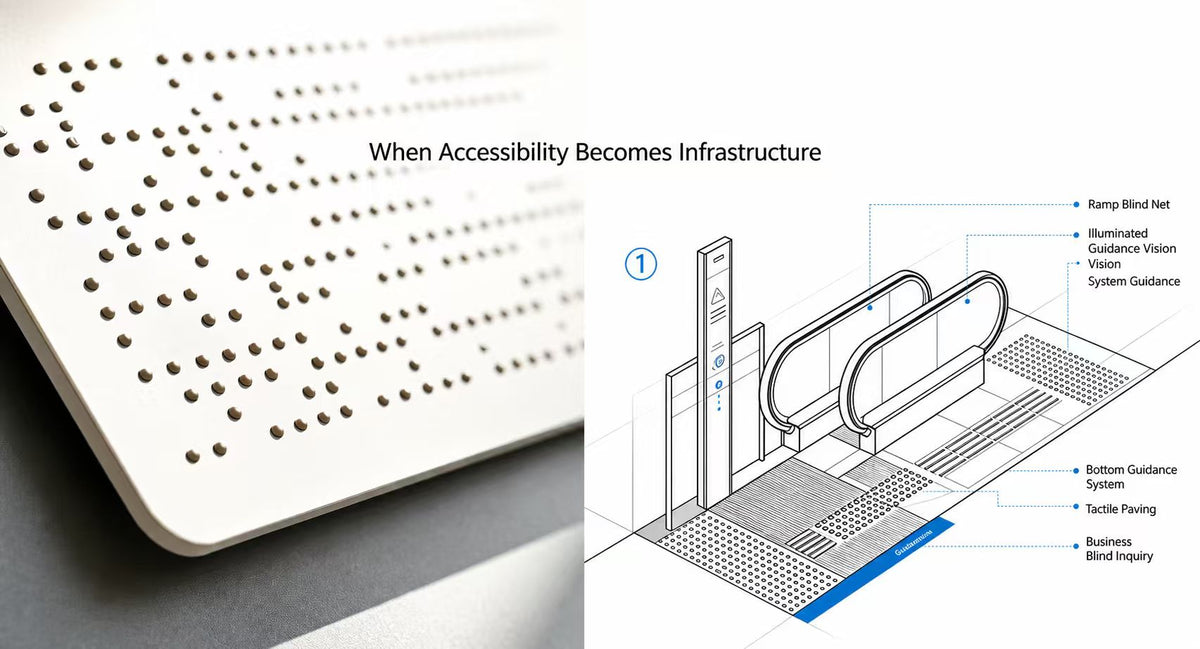
Global Accessibility Systems Are Entering a New Engineering Era
Accessibility is no longer just a compliance requirement for public buildings. Across global markets, it is rapidly becoming part of core infrastructure strategy.
As populations age and urban environments become increasingly complex, governments, developers, architects, and facility operators are under growing pressure to create environments that are not only legally compliant, but genuinely usable for visually impaired populations.
According to the International Agency for the Prevention of Blindness (IAPB), the global blind population is projected to increase from 43.3 million in 2020 to 61 million by 2050, while the number of people living with some form of vision impairment may reach 1.7 billion worldwide.

This shift is transforming accessibility from a specialized architectural consideration into a system-level engineering challenge involving:
- braille signage systems
- tactile wayfinding systems
- ADA-compliant signage
- accessible environmental graphics
- inclusive navigation infrastructure
- lifecycle accessibility management
At the same time, global accessibility projects are becoming increasingly difficult to execute consistently across regions, standards, and construction environments.
The industry is entering a new phase:
Why Many Braille Signage Systems Still Fail in Real Environments
Despite the expansion of accessibility regulations worldwide, many braille signage systems still struggle in practical use.
In real projects, accessibility failures often appear in subtle but critical ways:
- Braille signs technically comply with standards but are installed at unusable heights
- Tactile signage meets regulatory dimensions but lacks sufficient contrast for low-vision users
- ADA-compliant signage systems become inconsistent during manufacturing and installation
- Accessible wayfinding systems lose usability due to poor lifecycle coordination
As a result, many projects become:
This gap between compliance and usability is becoming one of the most important challenges in global accessibility engineering.
For developers, hospitality groups, healthcare facilities, educational campuses, and public infrastructure projects, the consequences include:
- inconsistent user experience
- operational accessibility failures
- increased retrofit costs
- regulatory disputes
- ESG and inclusivity risks
The Structural Problem: Fragmented Global Accessibility Standards
One of the largest obstacles in global braille signage implementation is the fragmentation of international standards.
Today's accessibility ecosystem operates across multiple overlapping regulatory frameworks:
- ISO accessibility standards
- ADA signage requirements in the United States
- GB/T tactile signage standards in China
- EU accessibility directives and sectoral regulations
- Industry interpretation systems such as BANA
Each system defines accessibility differently, including:
- braille dot dimensions
- tactile character spacing
- installation height
- visual contrast requirements
- material specifications
- environmental application logic
As projects move through the chain of:
Design → Manufacturing → Installation → Inspection
execution inconsistencies accumulate.
In many cases, accessibility systems fail not because standards are missing, but because standards cannot be translated consistently into deployable engineering systems.
This is why many global accessibility projects struggle to scale reliably across regions and project types.

Accessibility Is Shifting from Compliance to Infrastructure Engineering
Historically, accessibility signage was often treated as a final-stage compliance task.
That model is rapidly becoming obsolete.
Today, accessibility is increasingly integrated into:
- smart city infrastructure
- transportation hubs
- hospitals and healthcare facilities
- hotels and hospitality projects
- educational campuses
- commercial real estate developments
- ESG and sustainability initiatives
This evolution is changing how accessibility systems are evaluated.
Organizations are no longer judged solely by whether accessibility elements exist.
They are increasingly evaluated by:
- real-world usability
- consistency across environments
- lifecycle durability
- operational reliability
- inclusive user experience
This marks a major industry transition:
The LC Sign 4-Layer Accessibility Failure Model
Based on international accessibility project experience, LC Sign developed a structured engineering framework to analyze why tactile signage and braille systems fail in real environments.
The framework identifies four interconnected system layers:
Layer Core Risk
Technology Layer Standards cannot be consistently translated into executable systems
Cost Layer High precision conflicts with scalability
Execution Layer Fragmentation across design, manufacturing, and installation
Management Layer Lack of lifecycle governance and operational feedback
This model reveals an important industry reality:
Accessibility failures are rarely caused by a single defect.
Instead, failures typically emerge from cumulative system misalignment across the project lifecycle.
Case Study: Guangzhou Qiming School Accessibility Project
A practical example of this transition can be seen in the Guangzhou Qiming School project, where LC Sign deployed 631 precision tactile and braille signage units as part of its Touchpoint Initiative.
Unlike traditional compliance-focused projects, this implementation prioritized usability engineering.
Key system optimizations included:
- tactile reading height optimized to 1.1 meters for children
- layered tactile and visual wayfinding logic
- high-contrast visual support systems for low-vision users
- precision-controlled braille dot manufacturing
- contextual adaptation based on real spatial behavior
The project demonstrated a critical accessibility principle:
Usability defines functional accessibility.

Contact us to request a quotation for your signage project.
Why Accessibility Requires Lifecycle System Management
One of the biggest misconceptions in the industry is treating accessibility signage as a standalone product.
In reality, accessibility performance depends on the coordination of multiple interconnected systems:
- standards interpretation
- engineering translation
- manufacturing precision
- installation consistency
- operational maintenance
- long-term usability feedback
To address this challenge, LC Sign applies a Manufacturing-as-a-Service™ (MaaS™) approach that integrates:
- engineering validation
- production coordination
- traceability systems
- quality assurance
- lifecycle accessibility governance
This transforms accessibility from a fragmented installation task into a continuously managed infrastructure system.
The Future of Global Accessibility Systems
As global accessibility regulations continue expanding, the industry is entering a new operational era.
Future accessibility systems will increasingly require:
- cross-standard compatibility
- scalable engineering systems
- usability-driven design
- lifecycle governance
- digital traceability
- multi-sensory wayfinding integration
For global developers, architects, hotel groups, educational institutions, and public infrastructure operators, accessibility is becoming directly connected to:
- operational resilience
- public trust
- inclusive design strategy
- ESG positioning
- long-term asset performance
The next generation of accessibility systems will not be defined solely by compliance.
They will be defined by their ability to operate reliably in real-world environments.
Download the Full Accessibility Engineering White Paper
This article summarizes key insights from the LC Sign industry white paper:
Compliance Is Not Enough: Rethinking Braille Signage in Complex Wayfinding Systems
The full report explores:
- Global braille signage standards and accessibility regulations
- ADA, ISO, GB/T, and EU accessibility systems comparison
- The LC Sign 4-Layer Accessibility Failure Model
- Accessibility lifecycle governance strategies
- Tactile signage engineering methodologies
- The Guangzhou Qiming School accessibility case study
- Usability engineering for accessible environments
Recommended reading
Design for Logistics (DfL): Redefining Global Signage Project Success
5 Certifications behind LC sign’s Commitment to Quality and Credibility
From Pantone to Production: How Color Consistency Is Achieved in Sign Manufacturing
From Design to Reality: Why Equipment Matters in Modern Sign Production