

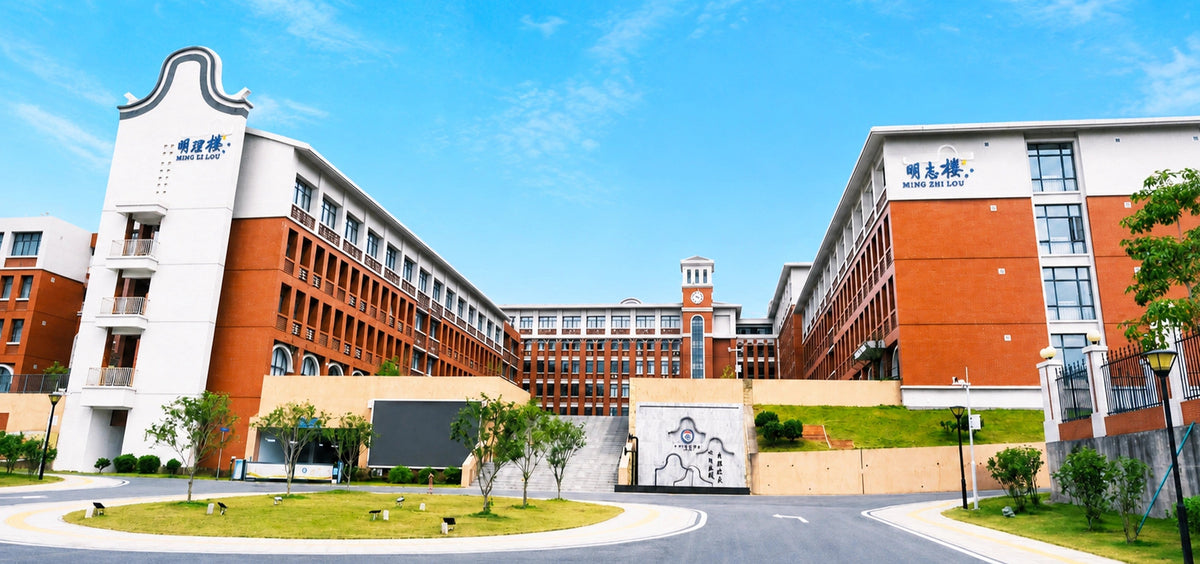
Overview
LC Sign delivered a comprehensive accessible wayfinding system for Guangzhou Qiming School, comprising 631 sets of Braille door signage across key campus areas, including teaching buildings, student dormitories, and administrative offices.
Guided by an "accessibility-first" design principle, the system adopts a 3mm white acrylic laser-engraved base combined with 3D-printed Braille dots, ensuring precise tactile readability, clear visual recognition, and long-term durability under high-frequency touch conditions.
From on-site research and multi-scheme validation to mass production and installation, the project was executed through a full-cycle process including user experience testing, standardized quality control, and meticulous on-site implementation—ensuring compliance with national Braille and accessibility standards while meeting the specific needs of a special education environment.

Context
Guangzhou Qiming School is a leading institution for visual impairment education in South China, offering programs from primary to vocational levels. The campus features a multi-building layout.
The existing Braille signage system faced several challenges:
- Low durability and susceptibility to wear
- Poor tactile clarity affecting readability
- Lack of integration between the needs of blind and low-vision users
These limitations hindered students' ability to independently navigate and recognize spaces within the campus.
The school required a signage partner capable of:
- Strict compliance with national Braille standards
- Dual-system design for both tactile (blind users) and visual (low-vision users) recognition
- Flexible installation across diverse building and wall conditions
- Ergonomic design suitable for students of different age groups
- High-precision Braille content verification and large-scale production capability
The project aimed to integrate ergonomics, visual design, and material engineering into a unified accessible wayfinding solution.

Challenges
1. Multi-layered Standards and User Requirements
Serving visually impaired students requires significantly higher standards for tactile accuracy and consistency. All Braille content and structures had to strictly comply with national standards while addressing diverse user groups and age ranges.
2. Integration of Tactile and Visual Systems
The project required simultaneous optimization of tactile readability (dot height, spacing, and layout) and visual clarity. Additionally, differentiated color strategies were needed to adapt to varying wall conditions (e.g., white vs. red walls), ensuring a cohesive and safe visual system.
3. Large-scale Custom Production and Proofreading
Producing 631 customized signage units involved extensive Braille proofreading and strict quality consistency. Traditional methods were insufficient to balance tactile quality, durability, and production efficiency.
4. Multi-scenario Implementation Coordination
The system had to adapt to various building types and wall materials while maintaining a unified numbering system. It also needed to ensure long-term durability under frequent touch and meet ergonomic installation requirements for different age groups.
Process
Phase 1: Site Research and System Planning
Conducted comprehensive site surveys and interviews with special education teachers to analyze student movement patterns and spatial recognition behavior. Established a hierarchical wayfinding logic system.
Phase 2: Design Development and User Validation
Developed both stainless steel and acrylic signage options. Through on-site tactile testing with students, the acrylic solution was selected. A color recognition system was created, including yellow borders for white walls to align with existing accessibility elements.

Phase 3: Process Optimization and Prototype Testing
Introduced 3D-printed hemispherical Braille dots, precisely controlled at 0.5mm height to balance tactile clarity and durability. Conducted real-world testing to refine tactile and visual parameters.
Phase 4: Detailed Design and Standardization
Finalized product structures and manufacturing standards. Developed unified dimensional specifications and installation guidelines. Established a dedicated proofreading process with school staff to ensure accuracy across all Braille content.

Phase 5: Mass Production and Quality Control
Adopted a hybrid process combining laser engraving and 3D printing. Implemented a full-process quality control system to ensure consistency in tactile performance, dimensions, and visual quality across all units.
Phase 6: Delivery and On-site Installation
Executed categorized packaging and phased delivery. Installation was carried out by a professional team, with height adjustments based on different student age groups. Final checks ensured compliance with all tactile and installation standards.


Contact us to request a quotation for your signage project.
Outcomes
1. Unified Accessible Wayfinding System
Successfully established a standardized Braille signage system across core campus areas, integrating tactile and visual recognition into a cohesive whole.
2. Full Compliance and High Precision
All 631 signage units meet national standards, achieving zero errors in Braille content and consistent tactile quality.
3. Enhanced User Experience
Ergonomic installation and optimized design significantly improved spatial recognition efficiency and independent mobility for visually impaired students.
4. Proven End-to-End Capability
Validated LC Sign's ability to deliver large-scale customized accessible signage systems, from research and design to production and installation, while overcoming traditional manufacturing limitations.
Insights
This project demonstrates that a user-centered approach—combined with full-cycle experience validation and standardized process control—can effectively deliver high-quality accessible wayfinding systems.
In special education environments, early-stage research, cross-user needs analysis, and the integration of innovative manufacturing techniques with strict standards are critical to success. Close collaboration with end users ensures both content accuracy and practical usability, allowing accessibility design to truly serve its intended audience.
Contact LC Sign to request a quotation for your signage project.
Recommended reading
Strategic Visual Engineering for Jambo Mart Commercial Complex
F45 Signage Expansion:Scalable LED Branding for Franchise Gyms
Custom Signage Package for Arena Sports Bar & Lounge
5-Star Interior Refresh: Custom Lightboxes for LA’s Oldest Barbershop
Recommended products
LC-XFL02 · LED Frontlit Rimless Letters & Signs